Orbixy
Spark Guide
Spark Guide
1. Problem Statement
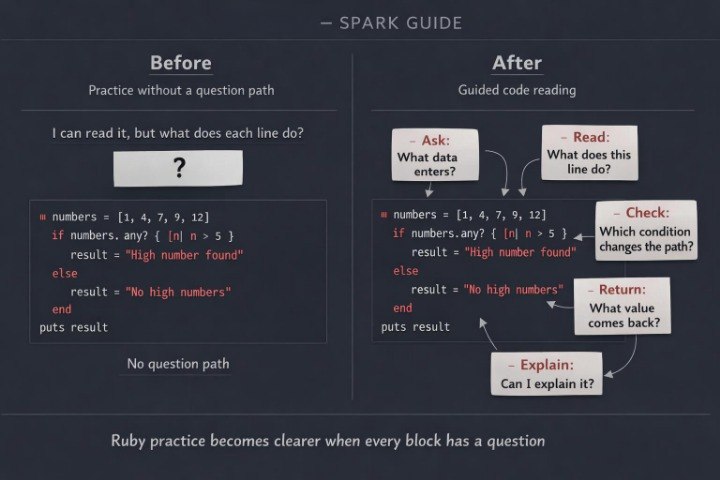
At this stage, a learner may already understand basic Ruby code structure, track data changes, and read small fragments. But another challenge often appears: the learner has knowledge and examples, yet still needs a clearer learning route inside each topic. A learner may know what a method, array, or condition is, but may not always know which question to ask during practice. Because of that, exercises can sometimes become mechanical, without deeper analysis of logic. Spark Guide is created to add more learning prompts, orientation points, and self-check questions to the study process.
2. Solution
Spark Guide connects Ruby programming with a guided learning format through short explanations, code comments, and practical prompts. The materials help learners not only complete tasks, but also understand why a certain action appears in the code. The plan gives attention to questions: what a method receives, what it returns, which data changes, where the check is placed, and how to read the result. Learners work with examples where each block has an explanation and a small exercise for review. This format supports careful study and helps learners see Ruby logic more clearly in practical situations.
3. What’s Inside
Spark Guide includes an expanded selection of materials with learning explanations, Ruby code examples, exercises, and comments on solutions. The first module focuses on working with Ruby topics through questions to the code rather than moving randomly. Learners review short fragments and learn to ask basic questions: which data enters the fragment, which action is performed, what changes, what returns, and which result appears at the end.
The second block focuses on commented code reading. The materials include Ruby fragments with explanations near key lines. Learners see why a variable receives a certain value, why a condition is needed, how a method uses a parameter, and where the final result is formed. This format helps learners stay oriented inside a fragment and read it in order, with an understanding of each part’s role.
A separate module is focused on practical prompts for methods. Learners review how to create methods, choose names for them, pass parameters, and return values. But the main focus is not the syntax; it is the thinking around a method. Each example includes questions: what the method should do, which data it needs, whether it does extra actions, and whether its name reads clearly.
The next part explores conditions. Learners analyze situations where code has several possible execution directions. The materials show how to read if, else, and elsif, how to compare values, and how to identify why Ruby selects a certain block. Exercises ask learners not only to write a condition, but also to explain it in words. This helps build a clearer understanding of checking logic.
Spark Guide also includes a module about arrays and simple work with data sets. Learners study how to ask questions about a list: how many items it has, which item is needed, which values match a condition, and what changes after adding or removing an item. Examples are built around small learning tasks where learners read data, perform an action, and explain the result.
The practical part of the plan contains three types of exercises. The first type is code reading with questions. The second type is completing a fragment using prompts. The third type is explaining a finished solution in simple words. This approach helps learners not only write Ruby code, but also describe its logic, which matters for further study.
The plan also includes “Guide Notes.” This is a set of short learning orientation points: how to read a method, how to check a condition, how to track a value, how to work with an array, how to notice repetition, and how to take notes after an exercise. These notes can be used as supporting material while moving through the lessons.
An additional block contains learning mini-scenarios. Each scenario includes starting data, a short task description, structure prompts, and self-check questions. Learners work with small Ruby fragments where they connect variables, conditions, methods, and arrays. The main focus is making each action understandable, not only written in code.
4. Who is this for?
Spark Guide is for learners who already know basic and middle-stage Ruby programming topics and want more learning explanations during practice. It is a good option for learners who can read code but want to understand the logic of each line more clearly. The plan may be useful for those who want to learn how to ask the right questions about code and analyze their own solutions more carefully.
This plan also suits learners who want to combine self-study with clear prompts. It continues Shift Module well because, after tracking code changes, it helps explain those changes in words more deeply. Spark Guide is intended for learners who care not only about moving through the material, but also about understanding how to think while working with Ruby.
5. What You’ll Learn
- How to ask questions while reading Ruby code.
- How to analyze the role of variables, methods, conditions, and arrays.
- How to read a Ruby fragment with comments and explanations.
- How to identify which data a method receives.
- How to understand which value a method returns.
- How to explain conditional checks in words.
- How to work with arrays through simple learning tasks.
- How to complete code using prompts.
- How to describe a finished solution in clear language.
- How to take notes after an exercise.
- How to notice repetition and extra actions in code.
- How to connect practice with careful analysis of Ruby logic.
6. Refund Terms
Spark Guide includes 30-day refund terms according to the Orbixy store policy. A learner may submit a request within 30 days after placing the order if the materials do not match expectations regarding format or content. Requests are reviewed according to the store policy and the plan description on the order page.
Couldn't load pickup availability
- 📄 Digital file available after purchase
- 📚 Long-term availability
- 🛡️ Secure checkout
- ✏️ Content updated in 2026
Self-paced learning overview
1. Are Orbixy courses suitable for learners who are new to Ruby programming?
1. Are Orbixy courses suitable for learners who are new to Ruby programming?
Yes, the materials are created so learners can gradually enter Ruby programming without overload. The lessons are built around clear explanations, code examples, and small practical tasks. Each plan has its own amount of materials, so learners can choose a format that matches their current pace.
2. How are the plans different from each other?
2. How are the plans different from each other?
The plans grow in order by the amount of materials, topic depth, and number of practical tasks. Starter plans introduce basic concepts, while higher plans add more structure, examples, modules, and practice. This helps learners choose a format that fits their current stage and learning goals.
3. What is included in the learning materials?
3. What is included in the learning materials?
Depending on the plan, learners receive lessons, modules, code examples, short explanations, practical exercises, topic-based selections, and additional resources. The materials focus on Ruby programming: syntax, logic, code structure, working with data, and building small programming solutions. All sections are arranged step by step so the learning path has a clear order.
4. Are there refund terms?
4. Are there refund terms?
Yes, paid plans may include a 30-day refund period according to the store terms. The Free Kit plan does not require payment, so refunds do not apply to it. Before choosing a plan, learners can review the description, included materials, and learning topics.
Share