Orbixy
Origin Pack
Origin Pack
1. Problem Statement
After the first introduction to Ruby programming, many learners ask how to continue without getting lost among new topics. A learner may already recognize variables, strings, numbers, and simple conditions, but may not yet understand how these parts work together in a larger code fragment. Without a clear order, it is possible to spend a lot of time repeating separate ideas without seeing the wider logic. The difficulty is often not in Ruby itself, but in materials that appear without a thoughtful learning route. Origin Pack is created to give learners a stronger base, more examples, and a calm move from reading code to writing simple structures independently.
2. Solution
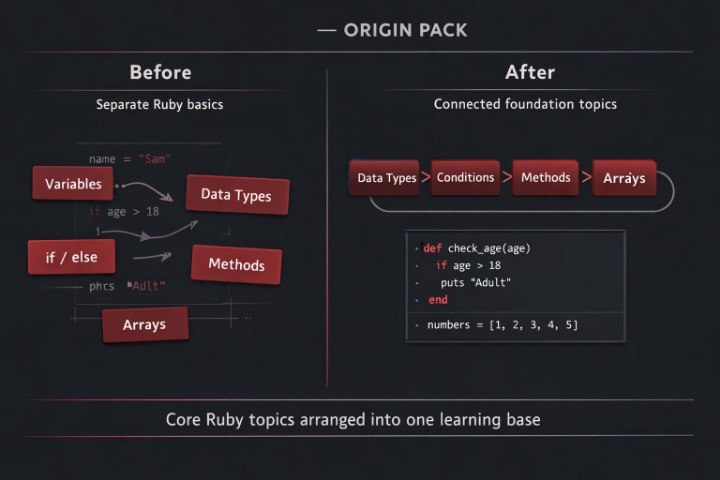
Origin Pack helps organize basic Ruby programming topics and shows how they work together. The materials are arranged through short modules, practical examples, and tasks that gradually add new elements to familiar ideas. Learners explore variables, data types, conditions, methods, and simple collections not as separate terms, but as parts of one working process. The plan focuses on code reading, logic explanation, and writing small fragments by hand. This format helps learners continue after the starter plan and understand how Ruby behaves in practical situations.
3. What’s Inside
Origin Pack includes an expanded set of learning materials for studying core Ruby programming topics. The first section reviews starter concepts, not as a dry list, but through examples where variables, strings, numbers, and logical expressions work together. Learners see how Ruby reads code from top to bottom, how values are stored, how data changes, and how simple instructions become a readable sequence of actions.
A separate module focuses on data types. It explains how Ruby works with text, numbers, true-or-false values, and empty values. The materials show why it is important to understand the difference between a string and a number, how to compare values, how to process simple expressions, and how to stay oriented while reading results. Instead of heavy theory, the plan uses small code fragments that can be read, changed, and analyzed.
The next section introduces conditions. Learners explore how if, else, and elsif work, how to build simple checks, how to compare values, and how to read the logic of branching. This section matters because conditions help code respond to different situations. The materials include exercises where learners identify which line will run, explain the reason, and write a small condition independently.
The following module is about methods. It explains why a part of code can be placed inside a method, how to name methods, how to pass simple parameters, and how to return a result. Learners see a method not as an overly complex idea, but as a way to organize code and make it more readable. The examples are built around simple actions: formatting text, calculating a value, checking a condition, and creating a short message.
Origin Pack also includes an introduction to simple collections. Learners meet arrays and basic actions with them: creating a list, referring to an item, adding a value, and reviewing several values. The materials explain how to read a collection not only as a group of data, but as a structure that a program can work with in order. This section prepares learners for later topics where collections appear more often.
The practical part of the plan contains tasks for reading, completing, and explaining code. Some exercises are built around finding an issue in a short fragment, while others focus on changing values and observing the result. There are tasks where learners describe in words what the code does, and tasks where they add one or several lines. This approach helps learners interact with the material instead of only looking at finished examples.
The plan also includes a learning route for self-study. It suggests the order for moving through modules, when to return to examples, how to take notes, and how to check understanding after each section. The route does not pressure the learning pace; it helps keep the materials organized.
In addition, learners receive a mini set of Ruby notes: short term explanations, syntax examples, common early-stage mistakes, and self-check questions. These materials can be used while reviewing topics or before moving to the next plan.
4. Who is this for?
Origin Pack is for learners who have already met the first Ruby programming concepts and want a more connected study of the foundation. It is a good fit for learners who understand what a variable, string, and simple condition are, but still want more practice and explanation. The plan may also suit people who started learning Ruby earlier, took a pause, and now want to return through structured materials.
Origin Pack is useful for learners who want to understand why code works the way it does, not only copy it. It fits self-study, foundation review, and preparation for wider Ruby programming topics. This plan does not require deep previous experience, but it works well for learners who are ready to read explanations, complete exercises, and gradually become familiar with Ruby syntax.
5. What You’ll Learn
- How to connect basic Ruby programming concepts into one sequence.
- How Ruby works with variables, text, numbers, and true-or-false values.
- How to read simple code fragments and explain their logic.
-
How to build conditions with
if,else, andelsif. - How to compare values and understand the result of a check.
- How to create simple methods and pass parameters into them.
- How to return a value from a method.
- How to work with basic arrays.
- How to find simple issues in code.
- How to take notes while learning Ruby programming.
- How to complete small practical exercises without jumping randomly between topics.
- How to prepare for later modules where wider code structures appear.
6. Refund Terms
Origin Pack includes 30-day refund terms according to the Orbixy store policy. A learner may submit a request within 30 days after placing the order if the materials do not match expectations regarding format or content. Requests are reviewed according to the store policy and the plan description on the order page.
Couldn't load pickup availability
- 📄 Digital file available after purchase
- 📚 Long-term availability
- 🛡️ Secure checkout
- ✏️ Content updated in 2026
Self-paced learning overview
1. Are Orbixy courses suitable for learners who are new to Ruby programming?
1. Are Orbixy courses suitable for learners who are new to Ruby programming?
Yes, the materials are created so learners can gradually enter Ruby programming without overload. The lessons are built around clear explanations, code examples, and small practical tasks. Each plan has its own amount of materials, so learners can choose a format that matches their current pace.
2. How are the plans different from each other?
2. How are the plans different from each other?
The plans grow in order by the amount of materials, topic depth, and number of practical tasks. Starter plans introduce basic concepts, while higher plans add more structure, examples, modules, and practice. This helps learners choose a format that fits their current stage and learning goals.
3. What is included in the learning materials?
3. What is included in the learning materials?
Depending on the plan, learners receive lessons, modules, code examples, short explanations, practical exercises, topic-based selections, and additional resources. The materials focus on Ruby programming: syntax, logic, code structure, working with data, and building small programming solutions. All sections are arranged step by step so the learning path has a clear order.
4. Are there refund terms?
4. Are there refund terms?
Yes, paid plans may include a 30-day refund period according to the store terms. The Free Kit plan does not require payment, so refunds do not apply to it. Before choosing a plan, learners can review the description, included materials, and learning topics.
Share