Orbixy
Neon Layout
Neon Layout
1. Problem Statement
After studying the first Ruby programming topics, learners often meet a new challenge: they can read code, but may not yet understand how to organize it well. Variables, conditions, methods, and arrays may be familiar separately, but writing a larger fragment can still feel confusing. The issue is often not a lack of knowledge, but the absence of a habit of seeing code structure as one complete scheme. Without attention to line order, names, repetition, and logic separation, even a small program can feel overloaded. Neon Layout is created to help learners work more carefully with the shape of code while keeping its meaning in focus.
2. Solution
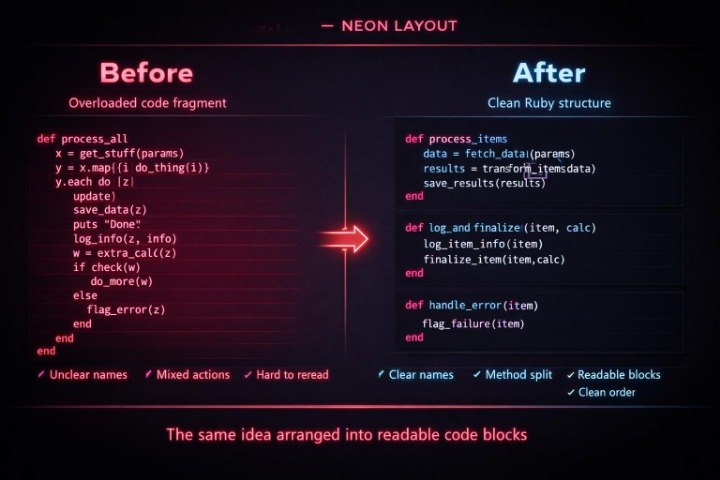
Neon Layout helps learners move from separate Ruby programming concepts to neat construction of small code fragments. The materials show how to place code, how to divide actions into parts, how to choose clear names, and how to notice repetition. Learners gradually study code not only line by line, but also by blocks: where an action begins, where it is checked, where data is processed, and where a result is formed. The plan gives attention to before-and-after editing examples, so learners can see how code perception changes. This approach helps learners understand Ruby not only as a set of commands, but as a language for building organized logic.
3. What’s Inside
Neon Layout includes a learning selection focused on Ruby code structure, block placement, and readability. The first module explains why order in code matters. Learners review short fragments where the same actions are written in different ways and see how names, indentation, method separation, and line order affect understanding.
The second section focuses on names. It covers variables, methods, and short logical parts of code. The materials show how a name can suggest the meaning of an action, why overly broad names make reading harder, and how to avoid chaotic abbreviations. Learners practice renaming variables, comparing several variants, and explaining which version reads more clearly.
A separate module explores methods as a tool for organizing code. Here, methods are viewed not only as a technical construction, but also as a way to divide code into logical parts. Learners see when a fragment can stay in place and when it may be better placed inside a separate method. Examples include text processing, simple checks, message preparation, and work with small data sets.
The next part focuses on conditions inside code structure. Learners review how not to overload conditional blocks, how to read nested checks, and how to simplify logic where appropriate. The materials show how the same check can be written in several ways and how the selected form affects reading. Exercises ask learners to explain execution flow, find extra repetition, and rewrite a small fragment in a cleaner form.
Neon Layout also includes a block about arrays and simple data passes. Learners study how to arrange work with lists so the code remains clear. Examples include going through values, filtering by condition, counting items, and creating a new list. The focus is not on task complexity, but on keeping logic organized.
The practical part of the plan includes code editing tasks. Some exercises provide a fragment that works but is uncomfortable to read. The learner’s task is to rewrite it so that names, order, and methods help the action become easier to understand. Other exercises focus on explanation: learners describe what a fragment does, where the main action begins, which lines handle checking, and which parts can be separated.
The kit also includes “Layout Notes” — short notes about Ruby code structure. They contain naming rules, indentation hints, examples of logic separation, a list of common structure issues, and self-check questions. These materials can be used during the modules or while reviewing topics.
Neon Layout also includes a mini learning project. In it, learners work with a small task: receive data, check conditions, process values, and form a result. The main goal is not complex functionality, but careful code construction. Learners gradually move from a messy fragment to a neat structure where each part has its place.
4. Who is this for?
Neon Layout is for learners who already know basic Ruby programming concepts and want to understand code structure more clearly. It is a good choice for learners who can read simple fragments but want to write them in a neater and more consistent way. The plan may be useful for those who notice that code sometimes works, but is hard to explain in words.
This plan also suits learners who want more practice with methods, conditions, names, and small data sets. It does not require broad previous experience, but it works better after meeting variables, conditions, methods, and arrays. Neon Layout helps learners develop attention to details that make Ruby code clearer during later review.
5. What You’ll Learn
- How to see Ruby code structure through logical blocks, not only separate lines.
- How to choose names for variables and methods.
- How to divide code into small clear parts.
- How to notice repetition in code.
- How to work with conditions without extra overload.
- How to read nested checks and explain their logic.
- How to use methods for organizing actions.
- How to work with arrays in simple practical tasks.
- How to edit a code fragment so it reads more clearly.
- How to describe code behavior in words.
- How to build a small Ruby fragment from an initial idea to a neat structure.
- How to use short notes for topic review.
6. Refund Terms
Neon Layout includes 30-day refund terms according to the Orbixy store policy. A learner may submit a request within 30 days after placing the order if the materials do not match expectations regarding format or content. Requests are reviewed according to the store policy and the plan description on the order page.
Couldn't load pickup availability
- 📄 Digital file available after purchase
- 📚 Long-term availability
- 🛡️ Secure checkout
- ✏️ Content updated in 2026
Self-paced learning overview
1. Are Orbixy courses suitable for learners who are new to Ruby programming?
1. Are Orbixy courses suitable for learners who are new to Ruby programming?
Yes, the materials are created so learners can gradually enter Ruby programming without overload. The lessons are built around clear explanations, code examples, and small practical tasks. Each plan has its own amount of materials, so learners can choose a format that matches their current pace.
2. How are the plans different from each other?
2. How are the plans different from each other?
The plans grow in order by the amount of materials, topic depth, and number of practical tasks. Starter plans introduce basic concepts, while higher plans add more structure, examples, modules, and practice. This helps learners choose a format that fits their current stage and learning goals.
3. What is included in the learning materials?
3. What is included in the learning materials?
Depending on the plan, learners receive lessons, modules, code examples, short explanations, practical exercises, topic-based selections, and additional resources. The materials focus on Ruby programming: syntax, logic, code structure, working with data, and building small programming solutions. All sections are arranged step by step so the learning path has a clear order.
4. Are there refund terms?
4. Are there refund terms?
Yes, paid plans may include a 30-day refund period according to the store terms. The Free Kit plan does not require payment, so refunds do not apply to it. Before choosing a plan, learners can review the description, included materials, and learning topics.
Share