Orbixy
Free Kit
Free Kit
1. Problem Statement
Many people begin Ruby programming with the feeling that too many new concepts appear at once. Syntax, variables, methods, data types, and code structure can feel disconnected when there is no clear entry point. Learners often need a short starter set that shows not only separate commands, but also how they connect. Without that kind of introduction, learning can turn into random reading across different materials without a clear order. Free Kit is created as a first orientation point that helps gather basic Ruby programming concepts into one clear picture.
2. Solution
Free Kit offers a calm beginning without extra pressure or complicated wording. The materials introduce the basic logic of Ruby programming through short explanations, simple code examples, and small tasks for checking understanding. Learners gradually see how Ruby works with data, how basic structures are written, and how to read code more carefully. The course does not create loud expectations; it gives a practical sample of the Orbixy learning approach. It is a useful way to understand whether the material style fits before moving to broader plans.
3. What’s Inside
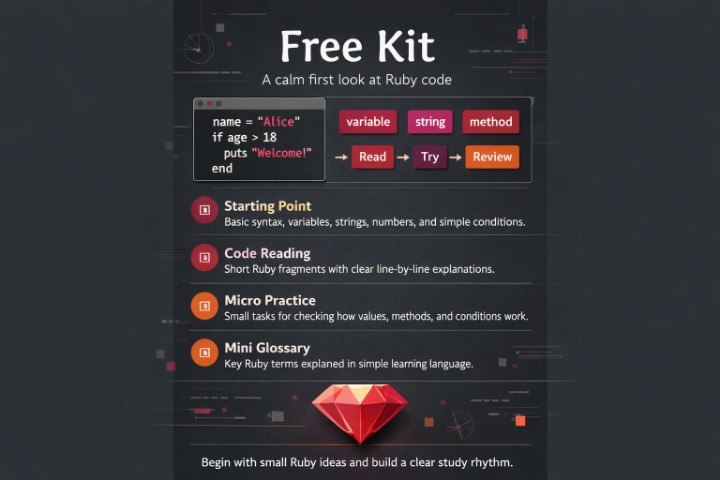
Free Kit includes a compact selection of materials that introduce Ruby programming basics and show how Orbixy learning is structured. Inside, there is an introductory module about the role of Ruby, its basic syntax, and what simple code looks like. Learners meet the ideas of variables, strings, numbers, simple conditions, and basic methods. The materials explain how to read short code fragments, how to notice logic inside lines, and how to stay oriented when new terms appear.
A separate section focuses on learning structure. It shows how to move from one topic to another, how to take notes, how to return to examples, and how to check understanding without rushing. The kit also includes several learning fragments with examples: declaring a variable, working with text, writing a simple condition, reading a short method, and completing a small code-reading task.
The kit contains a mini glossary of basic Ruby programming terms. It helps learners recognize words that often appear at the beginning of learning: variable, string, integer, method, condition, output. Explanations are written in simple language without unnecessary technical density.
Free Kit also includes a short learning route. It shows which topics may be explored after the starter plan: data types, conditions, loops, methods, arrays, hashes, and the structure of small programs. This is not a claim about a final outcome; it is a topic map that helps learners understand the order of study.
Another important part is the set of practical micro-tasks. They do not overload the learner, but they help apply the material: read a code fragment, find a variable value, explain how a condition works, add one line, or compare two ways of writing the same idea. This format supports careful learning and helps learners remember basic Ruby structures more clearly.
4. Who is this for?
Free Kit is for learners who are just starting with Ruby programming and want to begin with a small, clear section. It may also be useful for people who have already seen code but want to calmly review basic ideas without a large amount of material. This plan can be used as a first look at the Orbixy style: how topics are explained, how examples are arranged, and how practical tasks are presented.
Free Kit also fits learners who are comparing several plans and want to review the learning approach first. It does not require previous Ruby programming experience, but it works better for those who are ready to read examples carefully, take notes, and try small tasks. It is a starter set for learners who want to study Ruby gradually, without loud claims and without overload from extra topics.
5. What You’ll Learn
- What basic Ruby programming syntax looks like.
- What variables are and how they store values.
- How Ruby works with text and numbers in simple examples.
- How to read short code fragments and notice execution logic.
- What a method is and how it helps organize code.
- How a simple condition works.
- How to take notes while learning programming.
- How to move from one concept to another without jumping between topics randomly.
- How to complete small practical tasks for checking understanding.
- Which Ruby programming topics can be explored after the starter set.
6. Refund Terms
Free Kit is a free starter plan, so no payment is required. Because of that, the 30-day refund period does not apply to this plan. For paid Orbixy plans, you can include 30-day refund terms according to the store policy. A neutral wording for paid plans would be: “You may submit a refund request within 30 days according to the store terms.”
Couldn't load pickup availability
- 📄 Digital file available after purchase
- 📚 Long-term availability
- 🛡️ Secure checkout
- ✏️ Content updated in 2026
Self-paced learning overview
1. Are Orbixy courses suitable for learners who are new to Ruby programming?
1. Are Orbixy courses suitable for learners who are new to Ruby programming?
Yes, the materials are created so learners can gradually enter Ruby programming without overload. The lessons are built around clear explanations, code examples, and small practical tasks. Each plan has its own amount of materials, so learners can choose a format that matches their current pace.
2. How are the plans different from each other?
2. How are the plans different from each other?
The plans grow in order by the amount of materials, topic depth, and number of practical tasks. Starter plans introduce basic concepts, while higher plans add more structure, examples, modules, and practice. This helps learners choose a format that fits their current stage and learning goals.
3. What is included in the learning materials?
3. What is included in the learning materials?
Depending on the plan, learners receive lessons, modules, code examples, short explanations, practical exercises, topic-based selections, and additional resources. The materials focus on Ruby programming: syntax, logic, code structure, working with data, and building small programming solutions. All sections are arranged step by step so the learning path has a clear order.
4. Are there refund terms?
4. Are there refund terms?
Yes, paid plans may include a 30-day refund period according to the store terms. The Free Kit plan does not require payment, so refunds do not apply to it. Before choosing a plan, learners can review the description, included materials, and learning topics.
Share