Orbixy
Drift Collection
Drift Collection
1. Problem Statement
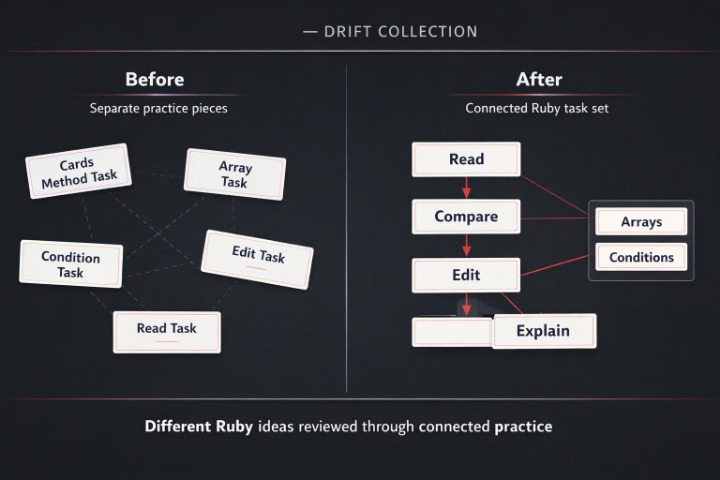
After several stages of Ruby programming study, a learner may know many separate topics but may not always see how they connect in a wider picture. Methods, conditions, arrays, data changes, and code structure may be familiar, but a new task can still raise the question of where to begin. The challenge often appears when learners need to choose between several ways of writing code or understand which approach fits a specific learning example. Without a set of connected tasks, learners may review topics separately without training the links between them. Drift Collection is created to help learners gradually gather different Ruby elements into a practical learning collection.
2. Solution
Drift Collection offers a set of connected materials where Ruby programming is studied through series of examples, exercises, and short learning scenarios. Learners do not work with one isolated topic, but with a collection of tasks where variables, methods, conditions, arrays, and execution logic appear together. The materials help learners compare solutions, analyze code structure, and see how small changes affect the result. The plan focuses on review through different contexts so familiar ideas do not remain static. This format helps develop more flexible thinking while working with Ruby code.
3. What’s Inside
Drift Collection includes a set of learning modules built around reviewing Ruby programming through different practical situations. The first module focuses on gathering familiar concepts into one working context. Learners review variables, data types, conditions, methods, arrays, and returned values, but not as separate topics; they appear as parts of small tasks.
The second block contains a series of Ruby fragments for comparison. In one example, a task may be written in a longer form, while another version uses cleaner separation into methods. Learners analyze how readability changes, where repetition appears, which names help explain the code, and which parts can be separated. This format helps learners look more carefully at writing options instead of treating the first solution as the only possible one.
A separate module focuses on data collections. Learners work with arrays, lists of values, and small sets of text and numbers. The materials show how to go through values, select needed items, change a list, form a new array, and count simple results. In exercises, learners do not only perform an action; they also explain what happens to the data at each step.
The next section explores conditions inside practical tasks. Learners review situations where the same code structure behaves differently depending on starting values. The materials include examples with checking text, numbers, list length, and whether a certain item is present. Tasks ask learners to identify which block runs, why it runs, and how that affects the final result.
Drift Collection also includes a block about methods as parts of a learning collection. Learners see how methods can appear across different tasks, change parameters, return different values, and work together with conditions or arrays. Special attention is given to keeping a method from becoming overloaded and keeping its purpose clear.
The practical part of the plan includes several themed exercise sets. The first set focuses on reading code. Learners receive a Ruby fragment and answer questions: which data enters, what changes, which method is called, which condition runs, and what appears at the end. The second set focuses on completing code. Here, learners finish a fragment using prompts and the structure already provided. The third set is built around editing: learners receive a working but overloaded example and gradually make it clearer.
The plan also includes “Collection Notes” — short learning notes for review. They contain tables with typical questions for code analysis, examples of variable and method names, reminders about arrays, condition prompts, and short checklists for fragment review. These materials can be used between exercises or before moving to the next plan.
An additional block contains learning scenarios with several execution variants. Learners see one task in different forms: a short version, a version separated into methods, a version with an array, and a version with a condition. The main goal is to compare approaches, not only look at finished code. This helps learners understand how Ruby can shape solutions in different ways within one learning topic.
The final part of the plan offers a small review set of tasks. Learners work with several Ruby fragments that connect variables, methods, conditions, arrays, returned values, and logic explanation. Each task has a short description, analysis prompts, and self-check questions. This format helps review materials not mechanically, but through careful use in different learning situations.
4. Who is this for?
Drift Collection is for learners who have already moved through several beginner and middle-stage Ruby programming topics and want to gather them into more connected practice. It is a good choice for learners who understand separate structures but want to see the links between them more clearly. The plan may be useful for those who want more tasks focused on reading, comparing, editing, and explaining code.
This plan also suits learners who want to review Ruby programming through different examples rather than through one long theory block. It continues Spark Guide well because, after learning prompts, it adds more sets for independent analysis. Drift Collection is intended for learners who want to work with Ruby more carefully, see different writing forms, and understand how familiar topics behave in new tasks.
5. What You’ll Learn
- How to connect several Ruby topics in one learning task.
- How to read code through input data, actions, conditions, and result.
- How to compare different ways of writing a Ruby fragment.
- How to work with arrays in different practical situations.
- How to analyze conditions inside wider code.
- How to use methods across several connected tasks.
- How to notice repetition and overloaded parts of code.
- How to edit a fragment so it is simpler to review.
- How to complete code using a provided structure.
- How to explain solution logic in simple words.
- How to use learning notes for topic review.
- How to work with a set of tasks where familiar ideas appear in new contexts.
6. Refund Terms
Drift Collection includes 30-day refund terms according to the Orbixy store policy. A learner may submit a request within 30 days after placing the order if the materials do not match expectations regarding format or content. Requests are reviewed according to the store policy and the plan description on the order page.
Couldn't load pickup availability
- 📄 Digital file available after purchase
- 📚 Long-term availability
- 🛡️ Secure checkout
- ✏️ Content updated in 2026
Self-paced learning overview
1. Are Orbixy courses suitable for learners who are new to Ruby programming?
1. Are Orbixy courses suitable for learners who are new to Ruby programming?
Yes, the materials are created so learners can gradually enter Ruby programming without overload. The lessons are built around clear explanations, code examples, and small practical tasks. Each plan has its own amount of materials, so learners can choose a format that matches their current pace.
2. How are the plans different from each other?
2. How are the plans different from each other?
The plans grow in order by the amount of materials, topic depth, and number of practical tasks. Starter plans introduce basic concepts, while higher plans add more structure, examples, modules, and practice. This helps learners choose a format that fits their current stage and learning goals.
3. What is included in the learning materials?
3. What is included in the learning materials?
Depending on the plan, learners receive lessons, modules, code examples, short explanations, practical exercises, topic-based selections, and additional resources. The materials focus on Ruby programming: syntax, logic, code structure, working with data, and building small programming solutions. All sections are arranged step by step so the learning path has a clear order.
4. Are there refund terms?
4. Are there refund terms?
Yes, paid plans may include a 30-day refund period according to the store terms. The Free Kit plan does not require payment, so refunds do not apply to it. Before choosing a plan, learners can review the description, included materials, and learning topics.
Share